Published March 05, 2026 | By Alyx E, Founder of Collectors MD
The concept of intentional collecting has become a central pillar of the work we’re doing at Collectors MD, offering collectors a healthier framework for engaging with the hobby. Seeing more people talk openly about setting limits, collecting mindfully, and prioritizing enjoyment over endless chasing makes me genuinely optimistic about where things are headed within our community.
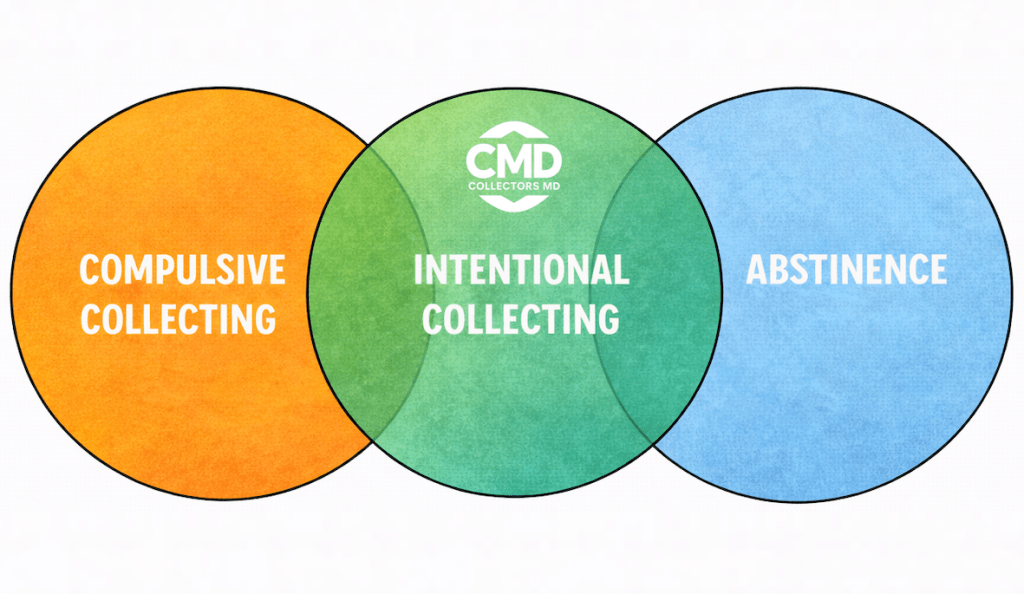
Intentional collecting is our version of harm reduction, the same framework often discussed in traditional recovery communities. Harm reduction has helped tens of millions of people live healthier lives by acknowledging that recovery doesn’t look the same for everyone. For some people, moderation and guardrails can be effective. For others, the only safe option is stepping away entirely.
Both realities can exist at the same time. But just like harm reduction in recovery spaces, intentional collecting can also become a slippery slope if we’re not honest about what’s really happening underneath the surface.
Many collectors eventually reach a point where they decide it’s time to reassess their relationship with the hobby. Maybe they step away for a while. Maybe they commit to a strict budget. Maybe they decide they’ll only collect certain players, certain teams, or certain sets. The intention is real. The challenge is that when someone steps away and later reengages, the environment that fueled the behavior in the first place is still exactly the same.
The same triggers are still present; Urgency. FOMO. Limited drops. Social validation. The dopamine rush of the chase. In fact, returning to the hobby after taking some distance can sometimes make those triggers reappear with more intensity. When you’ve been away for a while, there’s often a lingering sense that you’ve missed something. A hot new product hit the market. The “break of the decade” took place. Someone you know hit a life-changing card. The moment spreads across the hobby, and suddenly it feels like everyone else was part of it except you.
That feeling of “missing out” can quietly turn into “making up for lost time”. And that’s where intentional collecting can start to drift. The hobby itself constantly pushes urgency. Countdown timers. Limited quantities. Exclusive releases. Chat rooms and social media exploding when someone hits a monster card. Even when someone engages with a clear budget or set of rules, those boundaries can begin to blur once the moment takes over.
Self regulation becomes extremely difficult in an environment designed to weaken it. And psychologically, the brain remembers the reward. When someone steps back into that environment, even with the best intentions, the old dopamine loop can reactivate faster than expected. It rarely feels dramatic. Usually it’s subtle.
It’s late at night, you’re half-asleep, and your thumb taps “bid” while on on autopilot. One purchase becomes two. A single spot in a break turns into a personal box, then a personal case. Before long, the framework of intentional collecting has gradually loosened.
None of this means intentional collecting is impossible. We’ve seen firsthand that the approach can be effective for many people. Just like there are individuals who can have two drinks and stop, there are collectors who can engage with structure, limits, and accountability without slipping back into harmful patterns.
But there are also many people for whom moderation becomes something else. Sometimes harm reduction becomes justification. Instead of serving as a guardrail, it becomes a way to keep participating in a behavior that may actually require distance.
That’s why this conversation can become so contentious, both inside recovery communities and within the hobby itself. I’ve witnessed intense debates about this issue in both spaces. Some people firmly believe moderation is possible. Others believe abstinence is the only safe path for those struggling with compulsive behavior.
The truth is, both perspectives exist for a reason. At Collectors MD, we’re not here to force everyone into the same lane. We’re pro-awareness and pro-recovery. For some collectors, recovery means abstinence. For others, it means learning to collect with boundaries and accountability. Both paths deserve mutual respect.
Whichever path someone chooses, the most important step is honesty. Honesty about your limits. Honesty about your triggers. Honesty about the moments when boundaries begin to erode and rationalizations start to take their place. Honesty about how collecting actually affects you.
Intentional collecting isn’t a simple label or a lane we can just assign to people. It’s nuanced. It’s layered. What works for one person may be dangerous for another. That’s why there can’t be blanket solutions or a one-size-fits-all framework for the entire community. Each person owes it to themselves to take a hard, honest look at their own relationship with collecting and decide what path truly serves them.
Intentional collecting can absolutely work. But only when we’re willing to do the deeper work first – the kind of self-examination that asks whether moderation is truly sustainable, or whether stepping away is the safer path.
#CollectorsMD
Intentional collecting begins with a willingness to self-examine and take personal inventory before choosing to engage.
—
Follow us on Instagram: @collectorsmd
Subscribe to our Newsletter & Support Group
Join The Conversation On Mantel
Read More Daily Reflections