Presented By All Touch Case

One of the hardest parts of asking for help can be deciding whether what we’re experiencing is actually serious enough to deserve it. Maybe we spent more than we intended. Maybe we’ve started hiding purchases from the people around us. Maybe breaks, auctions, releases, or marketplaces are taking up more of our attention than they used to. Maybe we’ve told ourselves we were going to slow down, only to find ourselves right back in the same cycle a few days later.
Or maybe nothing dramatic has happened at all. Something just doesn’t feel right. When we think about getting help, it can be easy to imagine that there needs to be a clear line separating someone who has a “problem” from someone who doesn’t. We may convince ourselves that we haven’t lost enough money, damaged enough relationships, accumulated enough debt, or experienced enough consequences to justify reaching out.
So we wait. We tell ourselves we’ll get things under control after the next release or purchase. We’ll sell a few cards and make some of the money back. We’ll take a break after the weekend. We’ll set a budget next month. We’ll stop joining breaks once the product we’ve been chasing finally comes out.
But support doesn’t have to begin at rock bottom. In fact, one of the most valuable times to ask questions, create boundaries, or talk to someone may be when we first begin wondering whether our relationship with collecting or spending is changing.
You don’t need a diagnosis to recognize that something is affecting you. You don’t need to identify as having an addiction to acknowledge that your spending has become uncomfortable. You don’t need to understand exactly why you keep chasing something to recognize that you would like help stopping.
And you certainly don’t need to wait for things to get worse before taking the first step. Sometimes concern itself is enough information to act on.
That applies to the people around us, too. A spouse may notice changes in spending before the collector is ready to acknowledge them. A parent may see packages arriving every day and wonder what is happening. A friend may recognize that someone who once collected for fun now seems consumed by what they are buying, selling, pulling, winning, or losing.
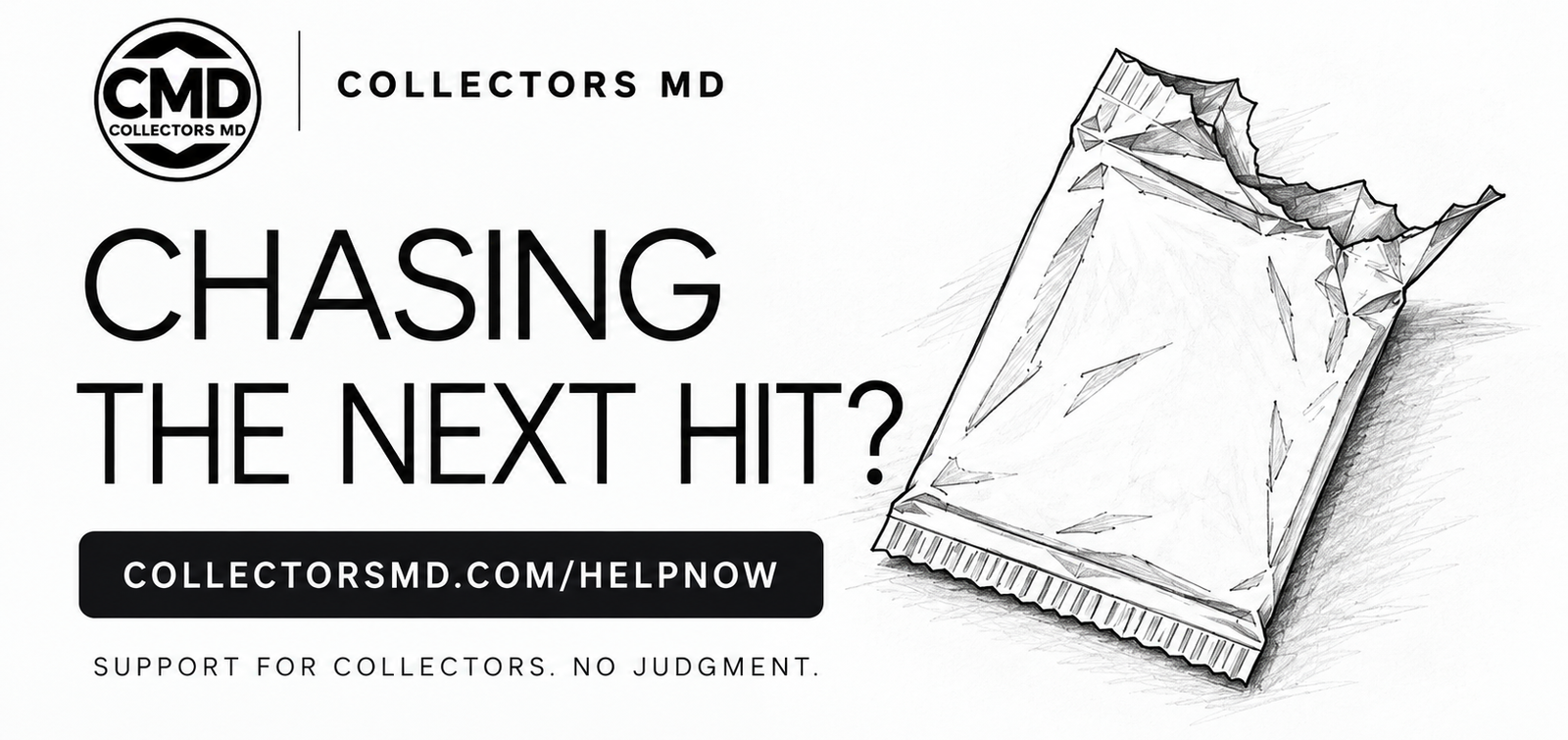
They may not know what to call it either. They shouldn’t have to. That’s why we created a new Help Now page within the Collectors MD ecosystem. We wanted there to be one simple place where a collector, family member, friend, colleague, or loved one could go when something doesn’t feel right and immediately understand what options are available.
Whether someone is experiencing an immediate emotional crisis, struggling with gambling or gambling-related behavior, concerned about compulsive collecting or spending, looking for professional support, or simply trying to understand what they are experiencing, the goal is to provide a clear next step.
No judgment. No labels. No requirement that you already know exactly what kind of help you need. Just a place to start.
Sometimes that next step may be joining a free peer-support meeting and simply listening. It may be talking with a clinician or treatment provider. It may mean removing saved payment methods, stepping away from live breaks or auctions, turning off purchasing notifications, or putting some distance between an urge and the ability to immediately act on it.
And sometimes the situation is more urgent. If you or someone you know is experiencing a mental health crisis or thoughts of suicide or self-harm, call or text 988. If there is an immediate emergency, call 911.
Collectors MD is not a crisis service, and peer support is not a substitute for professional mental health or medical care. Part of providing meaningful support is recognizing when someone needs a level of care beyond what a peer-support community can provide and making that pathway as clear as possible.
That’s also why asking for help shouldn’t feel like a commitment to a particular label, treatment path, or definition of what you are experiencing. It can simply be a decision to find out what support is available.
Maybe you visit the page today and realize a peer-support meeting feels like the right next step. Maybe you find a professional resource you didn’t know existed. Maybe you send the page to someone you’ve been worried about. Or maybe you read through it, recognize a few behaviors in yourself, and decide it’s time to pay closer attention. All of those are meaningful actions.
We talk frequently about collecting with intention and responsible engagement. But intention and responsibility aren’t only about deciding what we buy, what we collect, or how much we spend. They also mean being willing to recognize when our relationship with the hobby has started to change – and when it may no longer feel healthy, enjoyable, or in our control.
We don’t need to wait until we have all the answers. We don’t need to determine exactly where the line is. And we don’t need to prove that things are “bad enough” before reaching for support.
If something doesn’t feel right, that is reason enough to explore what help is available. Start there.
#CollectorsMD
You don’t have to know whether it’s a “problem” before asking for help. If collecting, breaking, buying, selling, or spending is becoming difficult to control – or you’re worried about someone you care about – support is available. Visit the new Collectors MD Help Now page for clear pathways to immediate crisis resources, peer support, professional help, and additional resources.
Collectors MD provides peer support and education and is not a crisis service or substitute for professional mental health, medical, substance-use, legal, or financial care. If you are experiencing an emergency, crisis, or immediate risk to yourself or others, please contact local emergency services or a crisis hotline immediately. If you or someone you know is struggling, experiencing emotional distress, or thinking about self-harm, help is available. In the U.S., you can call or text 988 to reach the Suicide & Crisis Lifeline. If you are outside the U.S., please contact your local emergency number or a trusted mental health resource in your country. You are not alone, and support is available.
—
Follow Us On Social: @collectorsmd
Join Our Support Group
Join Us On Mantel
Read More Daily Reflections
Support The CMD Foundation
This Daily Reflection is sponsored by All Touch Case, a premium display and protection solution designed to showcase your cards while keeping them safe. Use code COLLECTORSMD for 15% off your order. Collect. Protect. It’s a peace of mind.