Presented By All Touch Case

Sometimes the most important question isn’t what we call an activity. It’s what that activity is doing in our lives. Within the hobby, there can be a lot of discussion about where the line sits between collecting, entertainment, speculation, and gambling. Those conversations matter, and reasonable people can look at the same activity through different legal, clinical, industry, or lived-experience lenses. But for someone who is struggling, the terminology may not be the most important part of the conversation.
In peer-support meetings and conversations with people seeking help, we sometimes hear collectors describe experiences with ripping boxes, joining breaks, chasing cards, or other forms of randomized purchasing that feel remarkably familiar to experiences they have had with gambling. The anticipation. The uncertainty. The rush when something hits. The disappointment when it doesn’t. The urge to try again. The belief that the next outcome might make up for the last one.
That doesn’t mean every person who opens a pack of cards or joins a break is “gambling”. It doesn’t mean these activities affect everyone the same way. And it certainly doesn’t mean that the people, businesses, or platforms participating in the hobby are responsible for every individual experience. It simply means that uncertainty can affect different people differently.
When we purchase a specific card, we generally know what we are receiving. With randomized products or experiences, part of what we are purchasing can be the possibility of what we might receive. Sometimes the result exceeds our expectations. Sometimes it doesn’t. Sometimes we may receive cards worth considerably less than what we spent. Depending on the format of a break, there may even be occasions when a participant receives no cards at all.
For many collectors, that uncertainty is simply part of the entertainment. For others, particularly those with a history of gambling-related harm, compulsive spending, or difficulty managing urges, the experience of uncertainty and anticipation may affect them very differently. That distinction matters.
Randomness and anticipation are not new to collecting. The hobby has incorporated chase elements, limited inserts, mystery products, pack openings, and other uncertain outcomes in different forms for generations. What has changed dramatically is how quickly and easily we can engage with them.
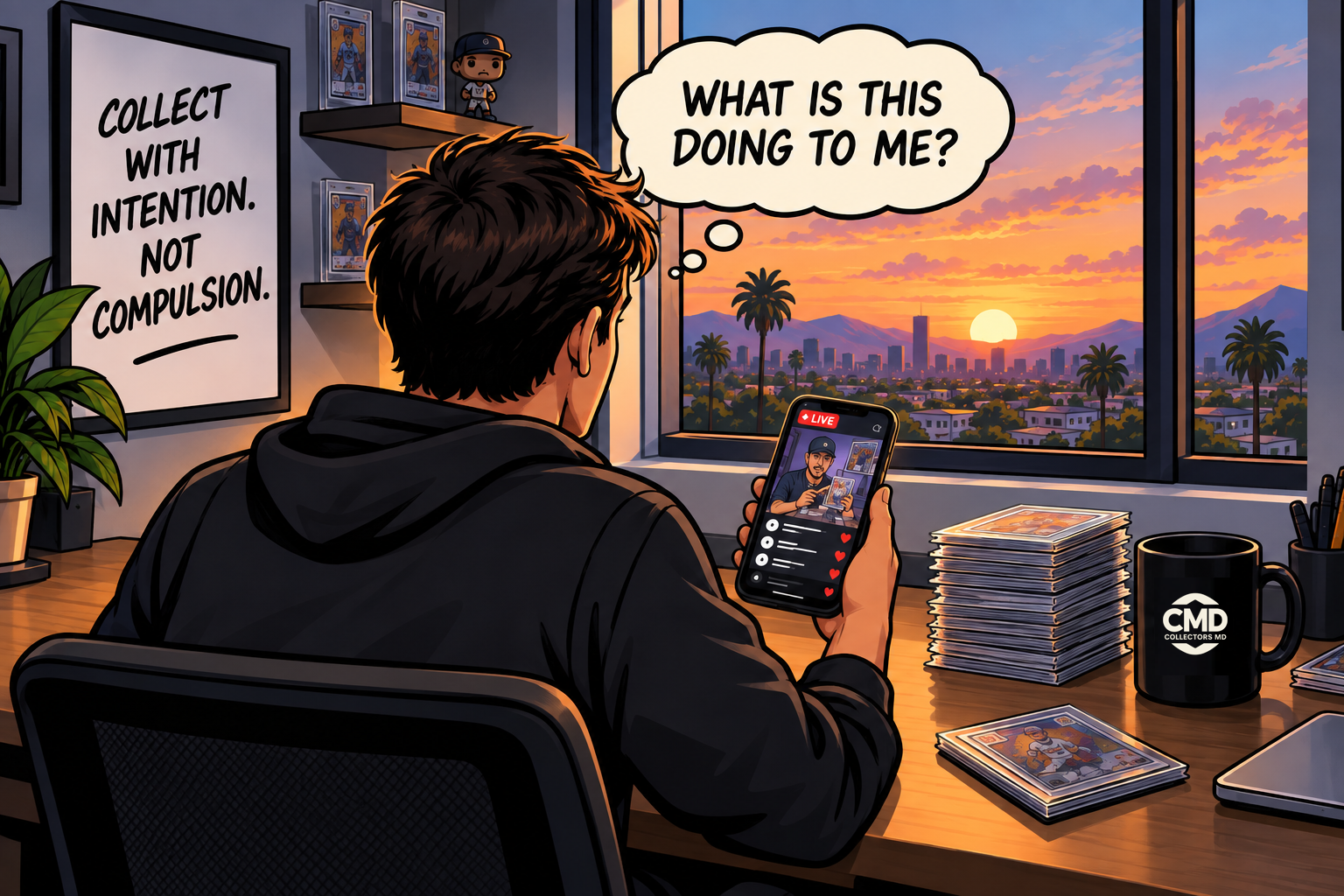
Collecting no longer necessarily requires waiting for a card show, visiting a hobby shop, finding a seller, or even leaving the house. Today, someone can watch a box being opened, purchase into a break, see the outcome, discover another opportunity, and make another purchase within minutes. Livestreaming, mobile marketplaces, social media, notifications, saved payment methods, and constant access have made collecting more convenient and connected than ever before. They have also changed the amount of time that can exist between an urge and our ability to act on it.
That reduced friction can be exciting and useful. It can also make self-awareness and personal boundaries increasingly important. The goal doesn’t have to be deciding that one activity is inherently good or bad. Instead, we can ask ourselves what happens after we participate. Do I feel satisfied, or immediately compelled to try again? Am I enjoying the experience itself, or primarily chasing a particular outcome? When I spend more than I intended, can I comfortably stop? Do I find myself trying to recover money from a previous purchase through the next break, box, or transaction? Has the accessibility of the hobby made it harder for me to create distance between an urge and a purchase? And perhaps most importantly: Does this still feel like collecting to me, or has my relationship with it started to feel like something else?
There doesn’t need to be one universal answer. Two people can participate in the exact same activity and experience it very differently. One may enjoy an occasional break as entertainment and comfortably walk away afterward. Another may find that the uncertainty activates a cycle of chasing, spending, regret, and trying again. Recognizing that difference isn’t an indictment of the hobby. It’s an opportunity to better understand ourselves within it.
We can appreciate collecting while also acknowledging that certain experiences may carry additional risk for some people. We can enjoy innovation and accessibility while recognizing that easier access may require stronger personal boundaries. And we can have thoughtful conversations about gambling-like mechanics without assuming that every collector who encounters them will experience harm. Most importantly, when someone tells us that an activity is affecting them in ways that feel similar to gambling, we don’t necessarily need to settle the terminology before taking their experience seriously.
If the behavior is becoming difficult to control, creating financial or emotional consequences, interfering with relationships, or repeatedly pulling someone back despite their intention to stop, that experience deserves attention regardless of the label attached to it.
At Collectors MD, our goal isn’t to tell people how they should collect or to define the hobby for everyone else. Our goal is to create space for people to recognize when their own relationship with collecting may be changing, understand the mechanics that may be affecting them, and find support when they need it.
Sometimes the most useful question isn’t, “What should we call this?” It’s, “What is this doing to me?”
If that question resonates with you, you don’t have to figure out the answer alone. Take a moment to explore our tools and resources, connect with our community, or join a Collectors MD peer-support meeting. Whether your goal is to step away, regain balance, or simply better understand your relationship with the hobby, support is available. If you or someone you know is in crisis or needs immediate support, visit our Help Now page.
#CollectorsMD
Not every collector experiences uncertainty, randomized products, ripping, or breaking in the same way. If an activity that once felt enjoyable has become difficult to control, financially harmful, or increasingly focused on chasing the next outcome, it may be worth paying attention to what you’re experiencing. You don’t need to settle on a label before asking for support.
—
Follow Us On Social: @collectorsmd
Join Our Support Group
Join Us On Mantel
Read More Daily Reflections
Support The CMD Foundation
This Daily Reflection is sponsored by All Touch Case, a premium display and protection solution designed to showcase your cards while keeping them safe. Use code COLLECTORSMD for 15% off your order. Collect. Protect. It’s a peace of mind.