Author: Alyx Effron

When The Headlines Hit The Hobby

Over the last 24 hours, the hobby has been flooded with headlines about legal challenges surrounding modern breaking practices. Stories like this tend to spread quickly. Opinions form fast. Social media fills with debate about who is responsible, who is wrong, and what should happen next. But beneath all of the noise, there is a deeper reality that many collectors have been quietly experiencing for years. For most people, collecting remains exactly what it has always been;

Read More »

The Scarcity Loop

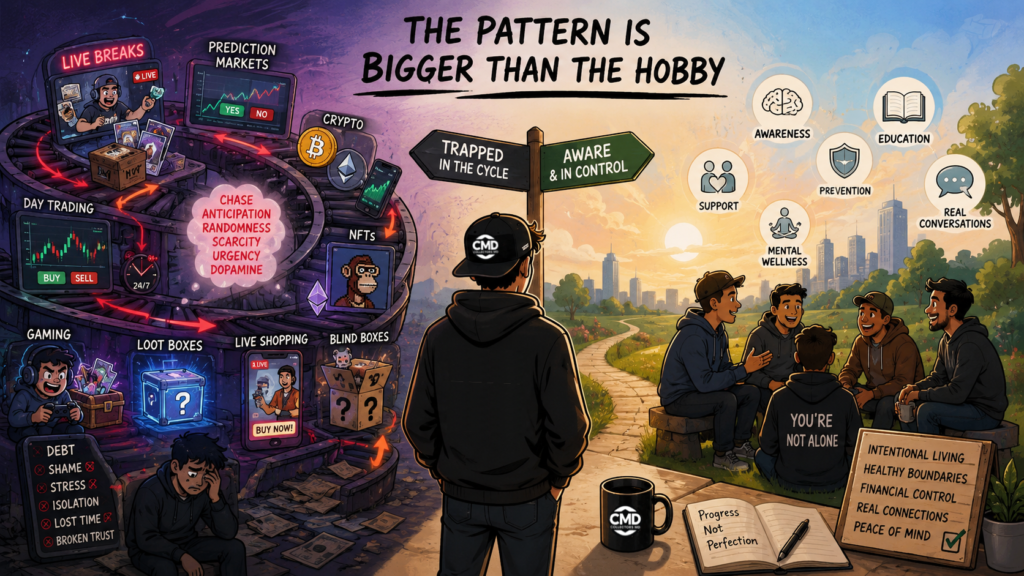
For most collectors, the hobby begins with something simple. A pack at the card shop. A favorite player. A memory tied to a moment in sports history. But over time, something subtle can change. The hobby starts to feel less like collecting and more like chasing. Not because collectors suddenly lose discipline or intelligence, but because many modern systems are designed to tap into a powerful behavioral pattern. Author Michael Easter calls this pattern the Scarcity Loop. It’s a simple three-part cycle that has

Read More »

Preserving The Spirit Of Collecting For The Youth

For generations, collecting has been one of childhood’s most simple and joyful rituals. Kids traded cards at lunch tables. They built small collections of their favorite players or characters. They saved allowance money to buy a pack at the local corner store, hoping to find something special. Collecting wasn’t about hitting a jackpot. It was about connection, curiosity, and pride in something that felt like an extension of your identity. In its purest form, collecting is still perfectly healthy for

Read More »

The Thrill Of Playing With Fire

There is a particular kind of thrill many of us remember from childhood – the feeling of “can I get away with this?” It was a rush that came with pulling off a prank or breaking a rule without getting caught. Pocketing a piece of candy from the corner store. Playing ding dong ditch. Vandalizing public property on mischief night. It wasn’t always about the act itself. Often it was about the electricity of the

Read More »

Problem Gambling Awareness Month

Every March, Problem Gambling Awareness Month (PGAM) invites us to pause and take a closer look at behaviors that often hide in plain sight. The goal isn’t to shame people or cancel activities that bring joy. It’s to raise awareness about the risks, the warning signs, and the support systems that exist for those who need them. The 2026 theme, “Caring Communities, Stronger Futures”, reminds us that awareness and accountability don’t happen in isolation. They happen when communities are willing

Read More »

The Slippery Slope Of “Intentional Collecting”

The concept of intentional collecting has become a central pillar of the work we’re doing at Collectors MD, offering collectors a healthier framework for engaging with the hobby. Seeing more people talk openly about setting limits, collecting mindfully, and prioritizing enjoyment over endless chasing makes me genuinely optimistic about where things are headed within our community. Intentional collecting is our version of harm reduction, the same framework often discussed in traditional recovery communities. Harm reduction has helped tens of millions

Read More »

Referral Network Announcement: Matthew Litt, Esq.

Collectors MD is proud to welcome Matthew Litt, Esq. to our growing referral network. Matthew is an attorney licensed in New York and New Jersey who has dedicated nearly his entire legal practice to challenging predatory gambling practices, particularly those involving casino VIP programs and host-driven incentives. He has appeared on The Whole Story with Anderson Cooper, ABC Nightly News with DeMarco Morgan, and Vice TV’s Out of Bounds, and has testified before multiple state

Read More »

Crashing Out

In today’s hobby, we’re seeing a phrase pop up more and more:“crashing out”. It usually refers to moments where frustration, pressure, or emotional overwhelm spills over in very public ways. Sellers breaking things on stream. Cracking slabs. Bending cards. Reacting when something sells far below expectations. And almost instantly, social media reacts like a hive mind – amplifying the moment, criticizing it, dissecting it. From the outside, it can be easy to reduce these moments to spectacle or judgment. But

Read More »

Referral Network Announcement: North Jersey Recovery Center

Collectors MD is proud to welcome North Jersey Recovery Center to our growing referral network of professional treatment providers. With locations in Fair Lawn and Cliffside Park, New Jersey, North Jersey Recovery Center provides comprehensive addiction and mental health treatment services for individuals seeking structured clinical support. Their programs are designed to treat the full spectrum of behavioral health challenges, combining evidence-based therapies, medical oversight, and individualized treatment planning to support long-term recovery. North Jersey

Read More »

Referral Network Announcement: Parents Standing Together

While Collectors MD provides peer support, education, and community for collectors navigating compulsive behaviors and high-risk spending patterns, we recognize that families are often navigating the impact alongside them. That’s why we’re proud to highlight Parents Standing Together as part of our growing referral network. Parents Standing Together is a parent-led nonprofit created by families with lived experience supporting children and young adults affected by problem gambling. Built by parents who discovered firsthand how difficult

Read More »

The Myth Of Liquidity In The Hobby

One of the most dangerous misconceptions in modern collecting is the idea that cards are “liquid”. The word gets thrown around casually, almost irresponsibly, as if owning a desirable card means you can turn it back into cash at will. That narrative sounds comforting. It also happens to be wildly misleading. What most people don’t see is how elongated the buying and selling process actually is. Liquidity in the hobby isn’t a switch you flip.

Read More »

When Dopamine Changes Addresses

Recovery has a way of creating open space. When one behavior is removed or slowed down, something else often rushes in to fill the gap. Sometimes that replacement looks healthier on the surface – more acceptable, more productive, more socially reinforced. But that doesn’t always mean it’s harmless. Social media is one of the most common places dopamine relocates. Likes, views, comments, followers, engagements – they deliver fast feedback and instant gratification. The brain doesn’t

Read More »