Presented By All Touch Case

Earlier this year, we explored how intentional collecting can become a slippery slope when we aren’t fully honest with ourselves about what’s happening underneath the surface. We discussed triggers, dopamine cycles, rationalization, and how quickly boundaries can erode inside an environment specifically designed to weaken self-regulation.
But there’s another layer to this discussion that may be even more important: How do people actually know which path is right for them in the first place?
At Collectors MD, we intentionally avoid forcing everyone into the same lane because recovery, behavior change, and harm reduction are deeply individualized. Some people truly can participate in the hobby in a structured, intentional, sustainable way. Others eventually realize that any level of engagement keeps them emotionally activated, financially unstable, mentally preoccupied, or trapped in constant cycles of urges and rationalization. There isn’t a one-size-fits-all strategy, because every person is navigating a different stage of their journey.
The fact of the matter is that both realities exist and both paths are equally valid depending on the individual. The difficult part is that vulnerability can distort self-perception.
A lot of people select “Intentional Collecting” because it feels less overwhelming emotionally than admitting they may need distance from the hobby altogether, at least temporarily. And honestly, that makes sense. Taking a full step back can feel scary. It can feel isolating. For many people, collecting goes far beyond the items themselves. It’s tethered to identity, routine, nostalgia, social connection, stimulation, escape, and emotional regulation all wrapped together.
So when someone is asked to choose between “Intentional Collecting” and “Abstinence”, there’s naturally going to be an internal pull toward the option that allows continued participation. That doesn’t automatically mean the choice is wrong. But it does mean we have to approach intentional collecting with an enormous amount of caution and honesty.
Intentional collecting is not casual moderation. It requires structure. Balance, boundaries, accountability, awareness, support, financial honesty, emotional honesty, trigger awareness, discipline, reflection, community, personal inventory, and most importantly, the willingness to recognize when the approach may no longer be working.
Without those things, harm reduction can slowly transform into justification. That’s why we’ve been spending a lot of time thinking about how we can better guide people through this process at Collectors MD.
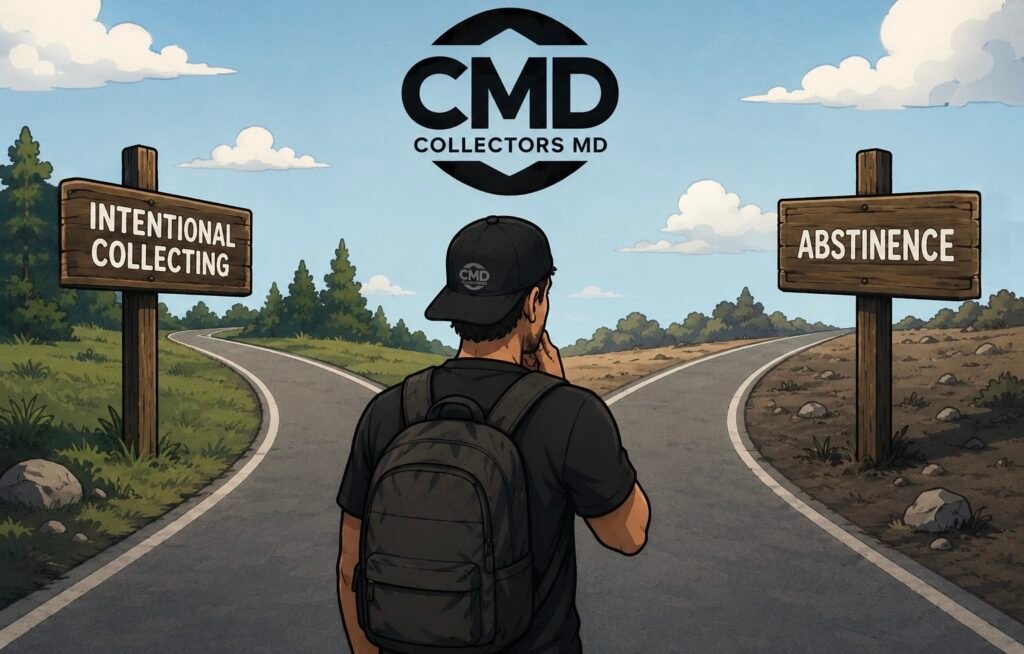
Right now, when someone signs up for our meetings, we ask: Which lane best aligns with where you are in your collecting journey right now?
- Intentional Collecting: Continuing to engage with the hobby in a mindful, structured way – setting clear limits, focusing on meaning over impulse, and practicing awareness around triggers and spending.
- Abstinence: Taking a complete break (either temporarily or permanently) from buying, selling, or engaging with hobby platforms to reset your relationship with collecting and rebuild healthier habits before returning (if at all).
But the reality is, this decision is rarely black and white. Someone may genuinely need abstinence right now, even if they hope intentional collecting becomes possible later. Someone else may successfully practice intentional collecting for years before recognizing certain environments or behaviors are becoming unsafe again. Another person may move back and forth between both approaches depending on where they are mentally, emotionally, behaviorally, and financially.
There’s also what we often describe as a hybrid model. Some collectors begin with a period of abstinence to create stability, clarity, emotional distance, and healthier habits before eventually reintroducing the hobby in a far more intentional way. Others may attempt intentional collecting first, only to later recognize that a full reset has become necessary.
Recovery and self-awareness rarely move in straight lines. Sometimes abstinence is actually simpler because it removes the negotiation entirely. Other times, intentional collecting can genuinely help someone rebuild a healthier relationship with collecting. The challenge is figuring out which reality applies to you before rationalization starts answering the question for you.
This is exactly why we’re currently working on refining the onboarding and self-assessment process for Collectors MD community members. Rather than asking vulnerable individuals to immediately self-select a lane completely on their own, we’re developing a simple questionnaire designed to help provide additional clarity, perspective, and guidance during that decision-making process.
The goal isn’t to shame people, force abstinence, or discourage intentional collecting – but to help individuals make more informed and responsible decisions based on their behaviors, patterns, triggers, emotional dependency, financial impact, and overall level of stability.
Sometimes the most dangerous thing a person can hear is exactly what they want to hear while they’re still vulnerable. At the end of the day, Collectors MD isn’t here to tell people which path they should choose. We’re here to help guide people toward greater awareness, honesty, accountability, and healthier decision-making within a hobby environment that can become incredibly emotionally and psychologically consuming very quickly.
The goal isn’t to protect the hobby at all costs. The goal is to protect the people participating in it.
#CollectorsMD
The right lane is the one that creates honesty, stability, and peace – not the one that simply keeps the door open.
—
Follow Us On Social: @collectorsmd
Join Our Support Group
Join Us On Mantel
Read More Daily Reflections
This Daily Reflection is sponsored by All Touch Case, a premium display and protection solution designed to showcase your cards while keeping them safe. Use code COLLECTORSMD for 15% off your order. Collect. Protect. It’s a peace of mind.